Political Firestorm Over ‘Epstein Files’: Hardeep Puri Rebukes Rahul Gandhi in Parliament
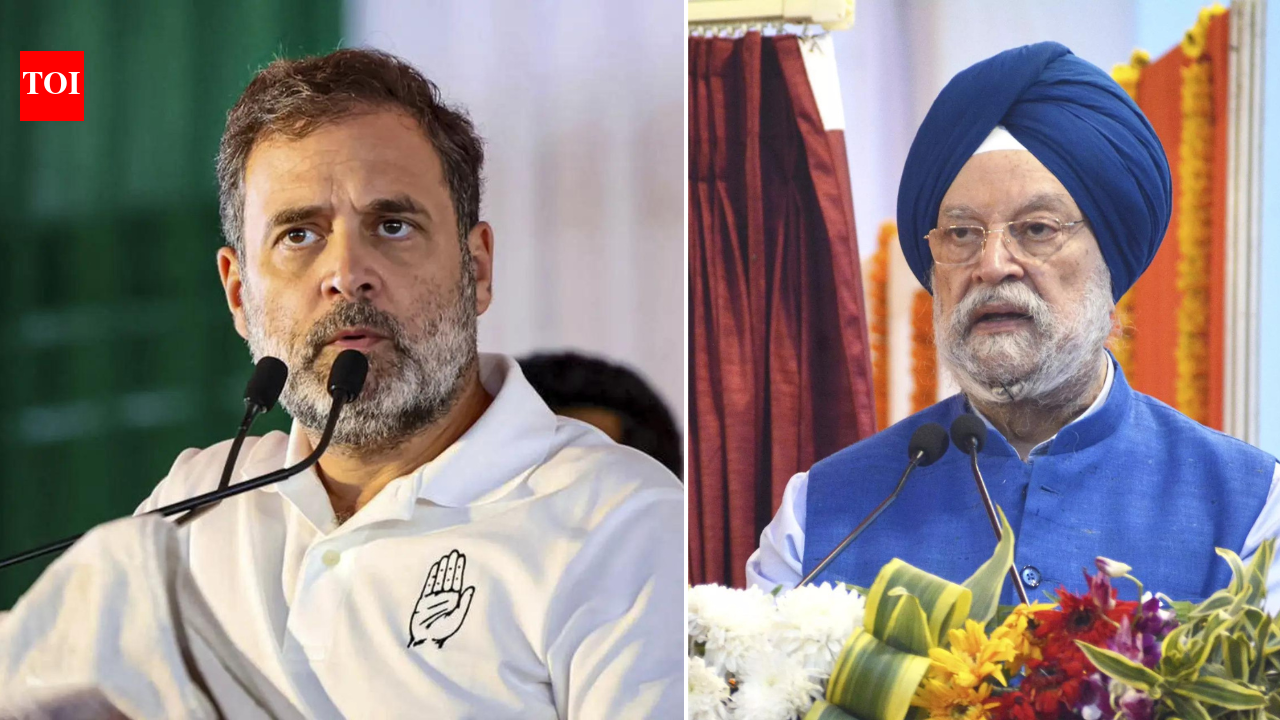
A sharp political exchange unfolded in Parliament after Congress leader Rahul Gandhi raised references to the so-called “Epstein files,” prompting Union Minister Hardeep Singh Puri to strongly rebut the insinuations and accuse him of indulging in “politics by innuendo.” The episode has once again highlighted how global controversies are increasingly being invoked in India’s domestic political discourse, often triggering fierce reactions across party lines.
At the centre of the row is the international controversy surrounding the late American financier Jeffrey Epstein, whose criminal case and associated investigations generated global headlines and widespread speculation about individuals allegedly connected to him. In several countries, political debates have occasionally referenced these developments, sometimes without formal evidence linking public figures to wrongdoing. In India, the issue surfaced in Parliament when Rahul Gandhi mentioned the matter during a debate, allegedly drawing an indirect association involving Hardeep Singh Puri.
The Parliamentary Exchange
According to proceedings and subsequent statements made to the media, Rahul Gandhi questioned the government over issues of transparency and accountability, invoking the broader context of international investigative disclosures. While he did not produce documentary evidence of direct involvement, his remarks were interpreted by the treasury benches as an attempt to cast aspersions.
Hardeep Singh Puri responded forcefully, rejecting what he described as baseless insinuations. He termed the remarks “politics by innuendo,” asserting that raising names in connection with global controversies without substantiated evidence undermines the dignity of Parliament. He further remarked that political leaders should “grow up” and engage in informed, fact-based debate rather than relying on insinuation.
Puri emphasized that public discourse must be anchored in verified facts and responsible argumentation. He warned that casually invoking names in connection with sensitive international cases not only damages reputations but also distracts from substantive policy discussions.
What Are the ‘Epstein Files’?
The phrase “Epstein files” generally refers to court documents, depositions, and investigative records associated with Jeffrey Epstein’s criminal cases in the United States. Epstein was arrested on charges related to sex trafficking of minors and died in jail in 2019. The case triggered intense scrutiny because of his associations with prominent global personalities from politics, business, academia, and entertainment.
Over the years, various documents have been released as part of legal proceedings and civil suits. These records often include references to numerous individuals, not necessarily as accused persons but sometimes as contacts, acquaintances, or individuals mentioned in testimonies. Legal experts have repeatedly clarified that being named in a document does not automatically imply wrongdoing, yet public perception can be influenced by mere mention.
This complexity makes the topic politically sensitive. Allegations, speculation, and partial disclosures have frequently fueled media debates and partisan narratives in several countries.
Politics and Perception
The controversy in Parliament reflects a broader trend where global scandals are used in domestic political sparring. In highly competitive political environments, leaders often invoke international developments to question opponents’ credibility or ethical standing.
Hardeep Puri’s criticism of Rahul Gandhi focused on this aspect. By characterizing the remarks as innuendo, Puri suggested that the intent was to create doubt rather than present verifiable evidence. He argued that responsible leadership requires careful distinction between documented facts and speculative associations.
The exchange also underscores how parliamentary debates can quickly escalate into headline-grabbing confrontations. Statements made inside the House are protected under parliamentary privilege, which allows members to speak freely without fear of legal repercussions. However, this freedom also demands a high standard of responsibility, given the weight such remarks carry.
Standards of Parliamentary Debate
India’s parliamentary traditions emphasize decorum, evidence-based argument, and accountability. Members are expected to substantiate allegations and avoid casting unverified aspersions. Over the years, Speakers and Chairpersons have intervened when debates cross into personal allegations without supporting documentation.
Political analysts note that invoking global investigative material in domestic debates requires careful handling. Legal processes in other jurisdictions may not have concluded, and partial disclosures can be misleading. The risk lies in conflating mention with guilt, which can distort public understanding.
Hardeep Puri’s response can be seen in this context—as a defense not only of his personal reputation but also of procedural norms within Parliament. By urging his political rival to “grow up,” he framed the issue as one of maturity and seriousness in public discourse.
Congress’ Broader Strategy
From the opposition’s perspective, raising issues related to transparency and global investigations may be part of a broader strategy to question the government’s accountability. Rahul Gandhi has often positioned himself as a critic of alleged opacity in governance, arguing that public officials must be open to scrutiny.
However, critics argue that without concrete documentation, such references risk appearing speculative. In high-stakes political environments, perception can overshadow nuance, and allegations—however indirect—can dominate news cycles.
The Congress party has historically adopted an aggressive tone in parliamentary debates when pressing the government on ethical or financial matters. The current exchange appears consistent with that pattern, though it has also drawn criticism for potentially stretching the relevance of international controversies to India’s political landscape.
The Media’s Role
Media amplification plays a crucial role in shaping the impact of such exchanges. Headlines often focus on the sharpest phrases—“needs to grow up” or “politics by innuendo”—which can overshadow the substantive issues originally under discussion.
Political communication experts observe that in today’s digital ecosystem, even indirect references can quickly trend on social media, sometimes detached from their original parliamentary context. This environment incentivizes dramatic language, increasing the likelihood of confrontations.
At the same time, responsible journalism requires distinguishing between allegations, documented findings, and political rhetoric. Coverage that clarifies what is known, what is speculative, and what remains under investigation helps prevent misinformation.
Implications for Political Discourse
The episode raises broader questions about the quality of political debate in India. Should global investigative controversies be invoked in domestic political battles? If so, under what evidentiary standards? How can Parliament balance freedom of speech with safeguards against reputational harm?
Democratic institutions rely on robust debate, but they also depend on trust. When allegations are made without detailed substantiation, the resulting polarization can erode confidence in both political leaders and institutional processes.
Hardeep Puri’s sharp rebuttal suggests that the ruling party views such tactics as an attempt to divert attention from policy issues. Meanwhile, the opposition may see raising uncomfortable questions as an essential part of democratic oversight. The tension between these perspectives is intrinsic to parliamentary democracy.
A Moment Reflecting Larger Trends
Beyond the immediate controversy, the exchange reflects the increasingly globalized nature of political narratives. Information flows across borders rapidly, and developments in one country can become talking points elsewhere. Political leaders must navigate this interconnected environment carefully, ensuring that references to international cases are accurate and contextually appropriate.
For observers, the key takeaway is the importance of fact-based debate. Allegations connected to sensitive criminal investigations carry serious reputational consequences. As legal experts frequently note, mere mention in investigative documents does not constitute proof of misconduct.
Conclusion
The heated exchange between Hardeep Singh Puri and Rahul Gandhi over references to the “Epstein files” underscores the intensity of India’s parliamentary politics. Puri’s charge of “politics by innuendo” and his admonition that his rival “needs to grow up” have added a personal dimension to what might otherwise have been a policy discussion.
Ultimately, the incident serves as a reminder that democratic debate thrives on evidence, clarity, and responsibility. While sharp disagreements are a hallmark of vibrant politics, maintaining the credibility of Parliament requires careful adherence to facts. In an era where global controversies can easily spill into domestic arenas, the burden on public representatives to exercise restraint and precision has never been greater.
afrikato afrikato afrikato afrikato afrikato afrikato afrikato afrikato afrikato afrikato afrikato afrikato afrikato afrikato afrikato afrikato afrikato afrikato afrikato afrikato afrikato afrikato afrikato afrikato afrikato afrikato afrikato afrikato afrikato afrikato afrikato afrikato afrikato afrikato afrikato afrikato afrikato afrikato afrikato afrikato afrikato afrikato afrikato afrikato afrikato afrikato afrikato afrikato afrikato afrikato afrikato afrikato afrikato afrikato afrikato afrikato afrikato afrikato afrikato afrikato afrikato afrikato afrikato afrikato afrikato afrikato afrikato afrikato afrikato afrikato afrikato afrikato afrikato afrikato afrikato afrikato afrikato afrikato afrikato afrikato afrikato afrikato afrikato afrikato afrikato afrikato afrikato afrikato afrikato afrikato afrikato afrikato afrikato afrikato afrikato afrikato afrikato afrikato afrikato afrikato afrikato afrikato afrikato afrikato afrikato afrikato afrikato afrikato afrikato afrikato afrikato afrikato afrikato afrikato afrikato afrikato afrikato afrikato afrikato afrikato afrikato afrikato afrikato afrikato afrikato afrikato afrikato afrikato afrikato afrikato afrikato afrikato afrikato afrikato afrikato afrikato afrikato afrikato afrikato afrikato afrikato afrikato afrikato afrikato afrikato afrikato afrikato afrikato afrikato afrikato afrikato afrikato afrikato afrikato afrikato afrikato afrikato afrikato afrikato afrikato afrikato afrikato afrikato afrikato afrikato afrikato afrikato