Artificial intelligence is rapidly transforming industries across the world, but the arrival of highly autonomous AI systems has also triggered a new wave of cybersecurity concerns. One AI model now dominating global discussions is Anthropic’s Claude Mythos — a system experts describe as one of the most advanced and potentially risky AI models ever developed.
Governments, central banks, cybersecurity researchers, and financial institutions are increasingly worried about the model’s reported ability to autonomously discover and exploit software vulnerabilities. In India, regulators and banking authorities have already begun assessing the possible risks posed by such AI systems to critical financial infrastructure.
The concern is not about AI replacing bank employees. The bigger fear is that highly capable autonomous AI tools could dramatically accelerate cyberattacks, expose hidden weaknesses in banking systems, and disrupt financial stability on a massive scale.
As India continues its rapid digital banking expansion, experts believe the country must act quickly to strengthen cybersecurity defenses before next-generation AI systems become more widely accessible.
What Is Claude Mythos?
Claude Mythos is reportedly an advanced AI model developed by Anthropic, the company behind the Claude family of AI systems. Unlike traditional chatbots designed mainly for conversation and productivity tasks, Mythos is believed to possess highly advanced autonomous reasoning and cybersecurity capabilities.
According to multiple reports, the model can identify software vulnerabilities, analyze large codebases, and perform complex cybersecurity tasks at speeds far beyond human capability. Some experts fear the same abilities that make the AI valuable for security testing could also make it dangerous if misused.
Anthropic itself reportedly restricted public release of the model because of concerns over cybersecurity risks. Global regulators and financial institutions have since started closely monitoring the technology and its implications for critical infrastructure.
The issue is not just theoretical anymore. Several governments have already raised national security concerns about frontier AI systems capable of autonomous cyber operations.
Why Banks Are Especially Vulnerable
Modern banks depend heavily on digital infrastructure. Payment systems, customer databases, online banking apps, ATMs, cloud servers, trading platforms, and interbank networks all rely on software working continuously without interruption.
However, many financial institutions still operate with a mix of modern systems and decades-old legacy infrastructure. These older systems may contain vulnerabilities that were previously difficult or time-consuming for hackers to discover.
Experts now warn that AI models like Mythos could dramatically compress the timeline between discovering a software weakness and exploiting it. Tasks that once required teams of skilled hackers working for weeks could potentially be automated within hours.
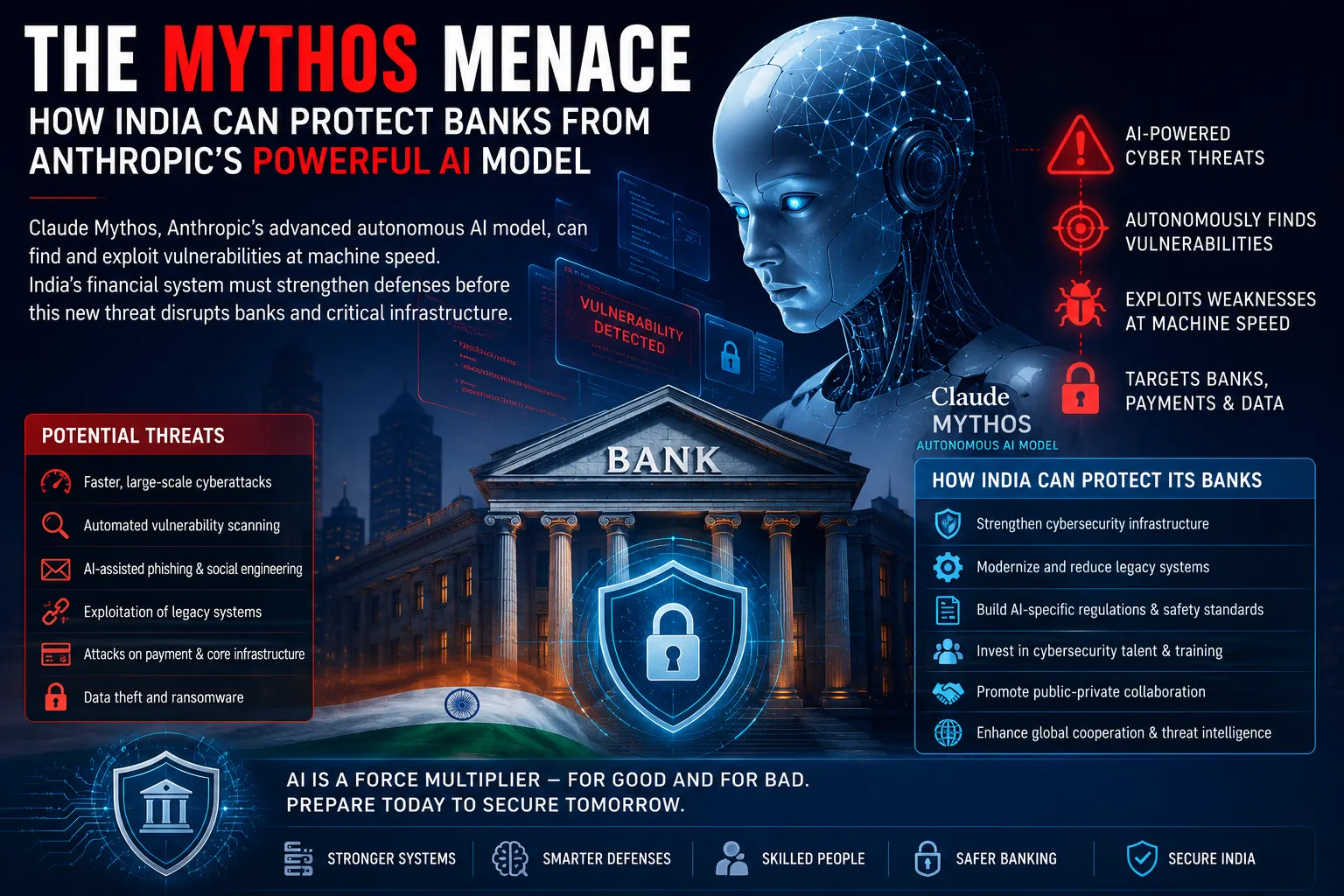
For banks, this creates several possible threats:
-
Faster cyberattacks
-
Automated vulnerability scanning
-
AI-assisted phishing campaigns
-
Exploitation of outdated software
-
Attacks on payment infrastructure
-
Data theft and ransomware operations
The scale and speed of AI-powered attacks could overwhelm traditional cybersecurity systems designed for slower and more predictable threats.
Why India Faces Unique Risks
India’s banking system is one of the fastest-growing digital financial ecosystems in the world. Unified Payments Interface (UPI), digital wallets, internet banking, and Aadhaar-linked financial services have transformed how millions of people access banking services.
While this digital transformation has increased convenience and financial inclusion, it has also expanded the country’s cyberattack surface.
India’s financial sector now handles billions of digital transactions every month. A successful AI-driven attack targeting payment systems or core banking infrastructure could potentially affect millions of users simultaneously.
Another major challenge is that many Indian banks still operate hybrid technology environments that combine modern digital platforms with older backend systems. Legacy software is often harder to secure and may contain vulnerabilities unknown to administrators.
Indian authorities have already begun reviewing the potential risks associated with advanced AI systems like Mythos. Reports indicate that the Reserve Bank of India and the Finance Ministry are closely monitoring developments.
The Dual-Use Problem of AI
One of the biggest concerns surrounding Mythos is the “dual-use” nature of advanced AI technology.
The same AI system that can help cybersecurity professionals identify weaknesses and improve defenses can also be used by malicious actors to launch attacks.
For example, an autonomous AI model could potentially:
-
Scan thousands of systems simultaneously
-
Generate exploit strategies
-
Automate malware modification
-
Bypass traditional security tools
-
Identify human behavioral weaknesses
Cybersecurity experts say this changes the entire economics of hacking. Smaller criminal groups with limited expertise could gain access to capabilities previously available only to elite nation-state hackers.
This is why regulators worldwide are becoming increasingly cautious about unrestricted deployment of advanced AI systems.
How India Can Protect Its Financial Infrastructure
Experts believe India still has time to prepare — but the response must be proactive rather than reactive.
Strengthening Cybersecurity Infrastructure
Indian banks need to significantly increase cybersecurity investment, especially in areas like threat detection, endpoint security, and real-time network monitoring.
AI-driven attacks may operate at machine speed, meaning traditional manual security responses may no longer be sufficient. Financial institutions will need AI-powered defensive systems capable of identifying suspicious behavior instantly.Several reports already suggest Indian banks are increasing cybersecurity budgets because of concerns related to advanced AI threats.
Reducing Dependence on Legacy Systems
Legacy infrastructure remains one of the weakest points in many financial institutions. Older software often lacks modern security architecture and may not receive regular updates.
Experts argue that banks must accelerate modernization programs, replace unsupported systems, and improve software auditing practices.
The challenge is that migration from older infrastructure can be expensive and operationally complex. However, delaying modernization may create even larger risks in the future.
Building AI-Specific Regulations
India may also need a dedicated regulatory framework for frontier AI systems.
Current cybersecurity rules were designed before autonomous AI became a realistic threat. Policymakers may now need to introduce:
-
AI safety standards
-
Mandatory AI risk audits
-
Reporting requirements for AI incidents
-
Restrictions on high-risk AI deployment
-
Financial-sector AI testing frameworks
Several global governments are already discussing stronger AI governance mechanisms as concerns about autonomous systems continue to grow.
Expanding Cybersecurity Talent
Another urgent priority is cybersecurity workforce development.
AI systems are evolving rapidly, but skilled cybersecurity professionals remain in short supply globally. India will need more experts trained in:
-
AI security
-
Ethical hacking
-
Threat intelligence
-
Cloud security
-
AI governance
-
Financial cybersecurity
Universities, banks, and technology firms may need to collaborate more closely to prepare the next generation of cybersecurity specialists.
International Cooperation Will Be Essential
Cyber threats powered by autonomous AI will not respect national borders. A vulnerability discovered in one country could be exploited globally within minutes.
This means India will likely need deeper cooperation with international regulators, AI companies, and cybersecurity agencies to share intelligence and develop common safety standards.
Reports already suggest India is engaged in discussions with global regulators and technology companies regarding AI-related cybersecurity risks.
The Future of Banking in the AI Era
The rise of systems like Claude Mythos represents a turning point in the relationship between AI and cybersecurity. While AI offers enormous opportunities for productivity and innovation, it also introduces risks unlike anything financial systems have faced before.
For India, the challenge is especially significant because of the country’s massive digital banking ecosystem and rapidly growing financial technology sector.
The solution is not to stop AI development. Instead, experts believe the focus should be on responsible deployment, stronger safeguards, better infrastructure, and faster adaptation.
The Mythos debate is ultimately a warning about the future. Autonomous AI systems are becoming more capable, more independent, and potentially more disruptive. Financial institutions that prepare early may strengthen their resilience. Those that delay could face risks evolving faster than traditional security systems can handle.As the AI race accelerates, cybersecurity may soon become one of the most important pillars of financial stability in the digital age.
releaseprcore.com releaseprcore.com releaseprcore.com releaseprcore.com releaseprcore.com releaseprcore.com releaseprcore.com releaseprcore.com releaseprcore.com releaseprcore.com releaseprcore.com releaseprcore.com releaseprcore.com releaseprcore.com releaseprcore.com releaseprcore.com releaseprcore.com releaseprcore.com releaseprcore.com releaseprcore.com releaseprcore.com releaseprcore.com releaseprcore.com releaseprcore.com releaseprcore.com releaseprcore.com releaseprcore.com releaseprcore.com releaseprcore.com releaseprcore.com releaseprcore.com releaseprcore.com releaseprcore.com releaseprcore.com releaseprcore.com releaseprcore.com releaseprcore.com releaseprcore.com releaseprcore.com releaseprcore.com releaseprcore.com releaseprcore.com releaseprcore.com releaseprcore.com releaseprcore.com releaseprcore.com releaseprcore.com releaseprcore.com releaseprcore.com releaseprcore.com releaseprcore.com releaseprcore.com releaseprcore.com releaseprcore.com releaseprcore.com releaseprcore.com releaseprcore.com releaseprcore.com releaseprcore.com releaseprcore.com releaseprcore.com releaseprcore.com releaseprcore.com releaseprcore.com releaseprcore.com releaseprcore.com releaseprcore.com releaseprcore.com releaseprcore.com releaseprcore.com releaseprcore.com releaseprcore.com releaseprcore.com releaseprcore.com releaseprcore.com releaseprcore.com releaseprcore.com releaseprcore.com releaseprcore.com releaseprcore.com releaseprcore.com releaseprcore.com releaseprcore.com releaseprcore.com releaseprcore.com releaseprcore.com releaseprcore.com releaseprcore.com releaseprcore.com releaseprcore.com releaseprcore.com releaseprcore.com releaseprcore.com releaseprcore.com releaseprcore.com releaseprcore.com releaseprcore.com releaseprcore.com releaseprcore.com releaseprcore.com releaseprcore.com releaseprcore.com releaseprcore.com releaseprcore.com releaseprcore.com releaseprcore.com releaseprcore.com releaseprcore.com releaseprcore.com releaseprcore.com releaseprcore.com releaseprcore.com releaseprcore.com releaseprcore.com releaseprcore.com releaseprcore.com releaseprcore.com releaseprcore.com releaseprcore.com releaseprcore.com releaseprcore.com releaseprcore.com releaseprcore.com releaseprcore.com releaseprcore.com releaseprcore.com releaseprcore.com releaseprcore.com releaseprcore.com releaseprcore.com releaseprcore.com releaseprcore.com releaseprcore.com releaseprcore.com releaseprcore.com releaseprcore.com releaseprcore.com releaseprcore.com releaseprcore.com releaseprcore.com releaseprcore.com releaseprcore.com releaseprcore.com releaseprcore.com releaseprcore.com releaseprcore.com releaseprcore.com releaseprcore.com releaseprcore.com releaseprcore.com releaseprcore.com releaseprcore.com releaseprcore.com releaseprcore.com releaseprcore.com releaseprcore.com releaseprcore.com releaseprcore.com releaseprcore.com releaseprcore.com releaseprcore.com releaseprcore.com releaseprcore.com releaseprcore.com releaseprcore.com releaseprcore.com releaseprcore.com