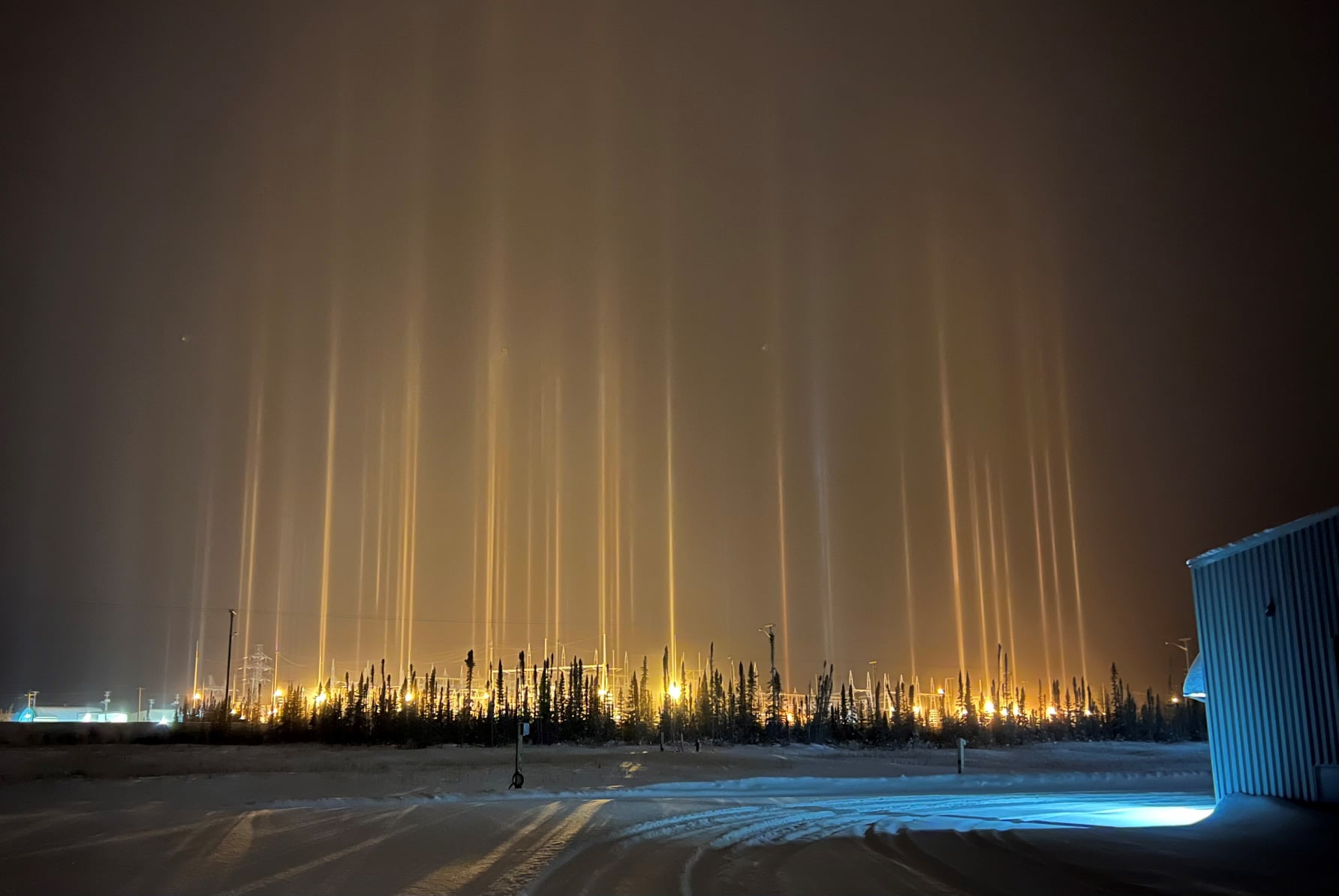
In recent years, photographs capturing mysterious light pillars glowing across snowy Canadian landscapes have fascinated people around the world. These dazzling vertical beams of light often appear to rise high into the sky, creating a magical scene against dark winter nights. In some images, the pillars shine in shades of white, blue, and even pink, illuminating frozen landscapes and leaving viewers wondering whether they are witnessing a rare cosmic phenomenon.
Despite their mysterious appearance, scientists explain that light pillars are not supernatural or extraterrestrial events. They are a natural atmospheric optical phenomenon caused by the interaction between light and tiny ice crystals suspended in cold air. The breathtaking images taken in Canada show how weather conditions and physics can combine to create extraordinary natural displays. Understanding the science behind this phenomenon reveals how delicate atmospheric processes can transform an ordinary winter night into a spectacular visual experience.
What Are Light Pillars?
Light pillars are vertical beams of light that appear to extend above or below a bright light source in the sky or on the ground. Although they look like solid columns of light, they are actually an optical illusion created by reflections of light in the atmosphere.
These pillars can originate from many different light sources. Streetlights, building lights, the Moon, and even the Sun can create these vertical beams when the conditions are right. The light is reflected by tiny ice crystals floating in the air, giving the impression that a glowing column is stretching upward into the sky.
Light pillars are often confused with other atmospheric phenomena such as auroras. However, unlike auroras that occur high in the atmosphere due to charged particles from the Sun, light pillars occur much closer to the ground and are purely a result of light reflection from ice crystals.
The Role of Ice Crystals in Creating Light Pillars
The key ingredient behind light pillars is the presence of tiny, flat ice crystals suspended in the atmosphere. These crystals usually form during extremely cold weather when moisture in the air freezes into small hexagonal plates.
Each of these crystals acts like a tiny mirror. When light from a lamp or another source hits the surface of these crystals, it reflects in a particular direction. When thousands or millions of crystals reflect light simultaneously, the reflections combine to create a visible beam of light that appears as a pillar.
These ice crystals often remain suspended in the air during calm winter nights. Because they fall slowly and maintain a horizontal orientation, they reflect light in a way that produces a long vertical column. The more crystals present in the atmosphere, the brighter and taller the pillar appears.
Weather Conditions Needed for Light Pillars
Light pillars only appear under very specific weather conditions, which is why they are considered relatively rare. First, the temperature must be extremely cold so that ice crystals can form and remain suspended in the air. In many cases, these phenomena occur when temperatures drop far below freezing.
Second, the air must be calm and stable. Strong winds can disturb the ice crystals, preventing them from aligning horizontally. When the air is still, the crystals can maintain the correct orientation needed to reflect light effectively.
Another important factor is the presence of humidity or ice fog. Moisture in the air provides the material needed for ice crystals to form. When cold temperatures, calm air, and ice crystals combine, the conditions become perfect for light pillars to appear.
These conditions are commonly found in regions with severe winter climates, such as northern Canada, Alaska, and parts of Russia.
Why the Pillars Glow in Different Colors
One of the most striking features of light pillars is their ability to display different colors. In photographs taken in Canada, the pillars often appear in soft whites, blues, or even shades of orange and pink.
The color of a light pillar depends largely on the light source that creates it. For example, if the light originates from a white LED streetlight, the pillar may appear white or blue. If it comes from sodium vapor streetlights, which emit a warm yellow glow, the pillar may appear orange or golden.
Similarly, pillars created by moonlight may appear pale white, while those created by sunrise or sunset may display subtle shades of pink or red. Because multiple light sources can contribute to the reflections, it is possible to see several colored pillars appearing simultaneously across the sky.
Why Canada Often Experiences This Phenomenon
Canada’s climate makes it one of the most common places in the world to witness light pillars. Large parts of the country experience long winters with extremely low temperatures, creating ideal conditions for ice crystal formation.
During cold winter nights, especially after snowfall, the atmosphere can fill with tiny ice crystals known as diamond dust. These crystals float gently in the air and act as reflective surfaces for artificial lights from towns and cities.
The combination of snow-covered landscapes, bright streetlights, and extremely cold temperatures makes Canadian regions particularly suitable for producing these dramatic light displays. As a result, photographers and weather enthusiasts frequently capture stunning images of light pillars across the country.
Light Pillars vs Auroras: Understanding the Difference
Many people who see images of light pillars for the first time mistake them for the famous Northern Lights, also known as auroras. While both phenomena can create beautiful light displays in cold regions, their causes are completely different.
Auroras occur when charged particles from the Sun interact with Earth’s magnetic field and atmosphere. This interaction produces moving curtains of colored light that stretch across the sky.
Light pillars, on the other hand, are not caused by solar particles. They are simply reflections of existing light sources off ice crystals in the atmosphere. Unlike auroras, which move and change shape constantly, light pillars usually remain stationary and appear directly above a light source.
Understanding this distinction helps scientists and observers identify the phenomenon correctly.
Why Light Pillars Often Spark Mystery and Curiosity
Because light pillars appear suddenly and can stretch high into the sky, they sometimes spark curiosity or even speculation about unusual causes. In the past, people have mistaken them for UFOs, mysterious energy beams, or supernatural events.
However, meteorologists and atmospheric scientists confirm that light pillars are entirely natural phenomena. They are simply the result of light interacting with ice crystals under specific weather conditions.
The illusion can be especially dramatic when several pillars appear at once, creating what looks like a glowing forest of vertical lights in the sky.
Conclusion
The mysterious light pillars seen in Canada demonstrate how nature can create breathtaking spectacles through simple physical processes. What appears to be a magical or otherworldly display is actually the result of light reflecting off millions of tiny ice crystals suspended in freezing air.
When cold temperatures, calm winds, and atmospheric moisture combine, these crystals act like mirrors that reflect light upward, forming the striking vertical beams known as light pillars. Although the phenomenon may look mysterious at first glance, science provides a clear explanation rooted in atmospheric optics.
These rare displays remind us that even the harshest winter environments can produce moments of extraordinary beauty. For observers lucky enough to witness them in person, light pillars transform ordinary winter nights into unforgettable experiences, proving that the natural world still holds many wonders waiting to be understood.
safersex.uk safersex.uk safersex.uk safersex.uk safersex.uk safersex.uk safersex.uk safersex.uk safersex.uk safersex.uk safersex.uk safersex.uk safersex.uk safersex.uk safersex.uk safersex.uk safersex.uk safersex.uk safersex.uk safersex.uk safersex.uk safersex.uk safersex.uk safersex.uk safersex.uk safersex.uk safersex.uk safersex.uk safersex.uk safersex.uk safersex.uk safersex.uk safersex.uk safersex.uk safersex.uk safersex.uk safersex.uk safersex.uk safersex.uk safersex.uk safersex.uk safersex.uk safersex.uk safersex.uk safersex.uk safersex.uk safersex.uk safersex.uk safersex.uk safersex.uk safersex.uk safersex.uk safersex.uk safersex.uk safersex.uk safersex.uk safersex.uk safersex.uk safersex.uk safersex.uk safersex.uk safersex.uk safersex.uk safersex.uk safersex.uk safersex.uk safersex.uk safersex.uk safersex.uk safersex.uk safersex.uk safersex.uk safersex.uk safersex.uk safersex.uk safersex.uk safersex.uk safersex.uk safersex.uk safersex.uk safersex.uk safersex.uk safersex.uk safersex.uk safersex.uk safersex.uk safersex.uk safersex.uk safersex.uk safersex.uk safersex.uk safersex.uk safersex.uk safersex.uk safersex.uk safersex.uk safersex.uk safersex.uk safersex.uk safersex.uk safersex.uk safersex.uk safersex.uk safersex.uk safersex.uk safersex.uk safersex.uk safersex.uk safersex.uk safersex.uk safersex.uk safersex.uk safersex.uk safersex.uk safersex.uk safersex.uk safersex.uk safersex.uk safersex.uk safersex.uk safersex.uk safersex.uk safersex.uk safersex.uk safersex.uk safersex.uk safersex.uk safersex.uk safersex.uk safersex.uk safersex.uk safersex.uk safersex.uk safersex.uk safersex.uk safersex.uk safersex.uk safersex.uk safersex.uk safersex.uk safersex.uk safersex.uk safersex.uk safersex.uk safersex.uk safersex.uk safersex.uk safersex.uk safersex.uk safersex.uk safersex.uk safersex.uk safersex.uk safersex.uk safersex.uk safersex.uk safersex.uk safersex.uk safersex.uk safersex.uk safersex.uk safersex.uk safersex.uk safersex.uk safersex.uk safersex.uk safersex.uk